Friday, October 6, 2017

Boxes that Look Like Books


Custom built boxes are a useful preservation tool, but they don't have to look like boxes. The enclosures above were commissioned for two specific projects. The one on the left, bound in British tan goatskin with blind tooling and a raised band spine, was built for an important original score. The box on the right houses a very special copy of Judah Paddock's Narrative of the Shipwreck of the Ship Oswego (1818). The narrative had been well used and came to me in a very sailorly binding. When the original spine failed, a long dead sailor thrice rammed an awl through the spine and boards about an eighth of an inch in from the spine folds. He then used tarred marlin to hold the entirety together. I read it in this way, but it was not a book one could loan out. Yet, it had so much character that I didn't want to rebind it in the standard way. What I did was chain stitch the book on its original stations with two bristol stubs front and back. These were let in to the original boards.  As a final touch, I used linen cord threaded through the original holes in the cover. Thus, I maintained its original character while making it easily readable once again. But how to title a spineless book?

My solution was to build a book shaped box. I've been experimenting with tree calf and it seemed like a suitable project for further experimentation. Tree calf is produced using chemical reactions on undyed calfskin and is meant to give the appearance of a branching tree on the covers.  The resulting box provides protection for the original unorthodox binding and allows for titling and placement on a standard set of shelves. 


Tuesday, September 22, 2015

Colorful Lettering Patches

four different colored leather patches

In the world of lettering patches, this is a rather colorful collection. Normally, there is more accord in an edition. But in this case, it seemed appropriate. The client provided me with the entire collection of Tintin books, some 23 in all. The covers were stripped, they were each disbound and then were resewn in four separate volumes. They were resewn so that I could physically attach the book covers to the pages using the cords each signature was sewn onto. Whenever possible, I avoid cased bindings where the cover is built off the book and then simply glued onto the textblock. I prefer the more robust and long-lasting laced binding, especially with a collection like this that will likely be read for generations.


Thursday, August 27, 2015

An Oldstyle Book for Newlyweds


custom book bound in calf
Oversized books are fun, but they are a chore to make. Crafting them becomes something of a workout as they are moved about the shop for various operations.  The client wanted a three and a half inch thick text block in a size slightly larger than my typical books. None of the boards and endpaper sections that I prepare when times are slow would do. Everything had to be made from scratch. The signatures were folded down from large press sheets and sewn on extra thick cords. The covers were made up of laminated board stock I then shaped with a hand plane and much sanding. The client was inspired by ancient books she had seen in Spain, so I dyed the calfskin leather binding in a style once popular in Spain and then blind tooled it. The central medallion was embossed with a hand carved wooden block given me by my teacher in Morocco.

hand dyed calfskin leather book


Just as a father's love is increased by the struggle to mold his child into the best person possible, the extra effort involved in making a big book tends to increase my affection for the oversized lout.  I was sad to send it off.

Wednesday, August 19, 2015

Leather Reback

reback leather binding

leather book repair
The reback is a bookbinding staple: keep the boards but replace the spine with as little intrusion into the textblock as necessary. The owner of this book is a reader and wants functional copies that open well and look good on the shelf. Often times I am able to retain the original spine and reattach it over the new leather, but in this case it was necessary to blend in a new one, including the labels. The leather was hand dyed and the labels done in imitation of the original using handle letters.

Friday, August 14, 2015

Sherlock Holmes in Leather

leather bound Sherlock Holmes

Something about Sherlock Holmes calls out for a leather binding, so when a client inquired about binding his set, I thought it would be a good idea to bind my copy as well. This is his, mine being a single, larger volume. The endpapers are made of maps of London featuring Baker Street. Reading these next to the fire on a rainy day feels rather Victorian, and I half expect a knock on the door by some fellow in a top hat and morning coat.  

Tuesday, August 4, 2015

Making a Facsimile Cover in Leather

tooling on cover

finish work on spine
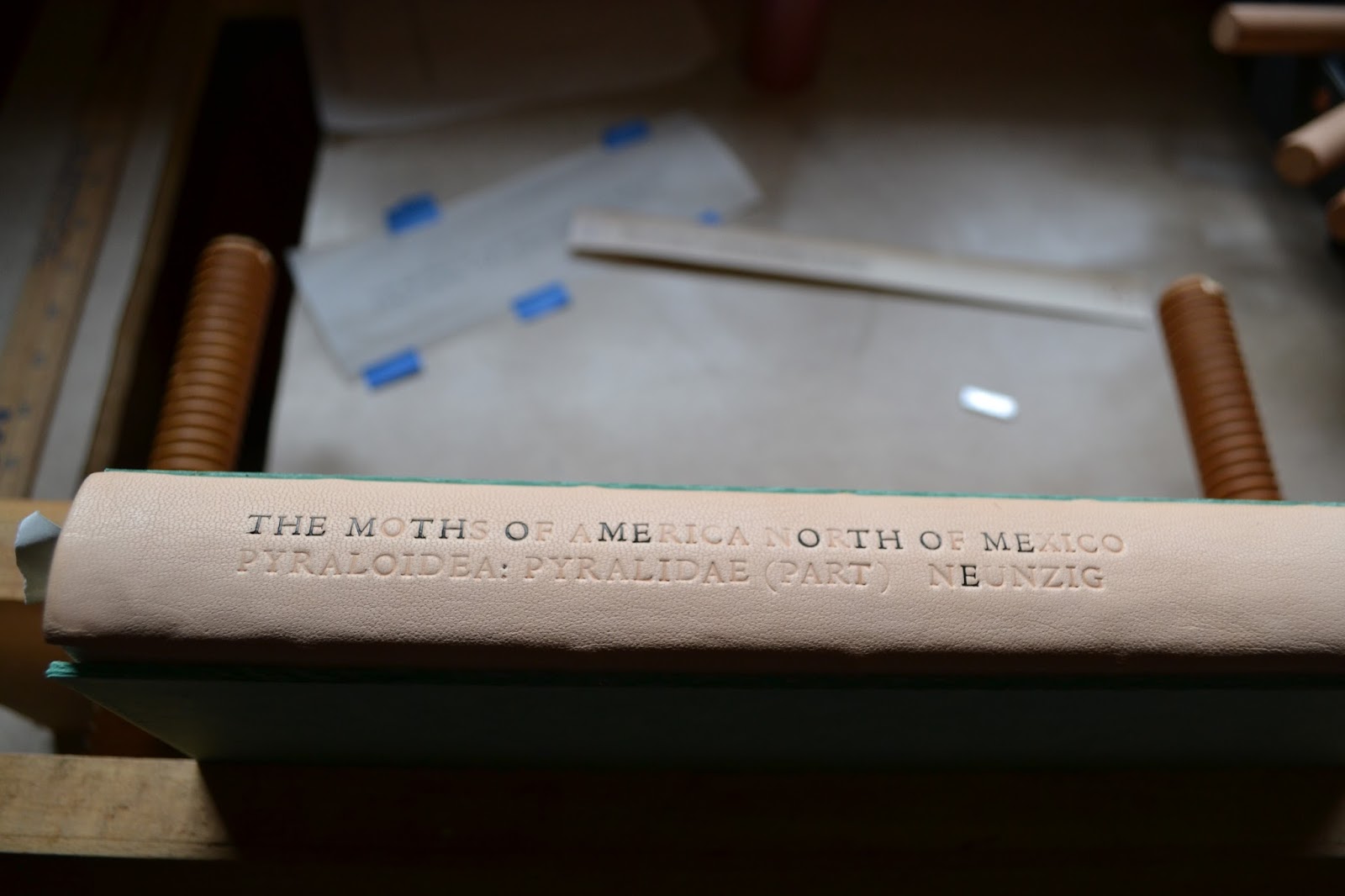
A local scientist wanted one of his many contributions to the study of moths to be leather bound. We decided to do a facsimile of the original paper cover in Siegel's fair goat. The front was fairly straightforward (if time consuming) work on the stamping press using a variety of foils and fonts. The spine was more difficult. I build the majority of my covers on the book which means all spine work must be done by hand. I printed out the text and then used my handle letters warm to impress each individual letter through the paper onto the spine. I then went over these impressions with the foil. I had to be gentle with the tool, using a light hand to allow the tool to nestle into the impression before applying the pressure necessary to print. I quite liked the final result which reminded me of old French paperbacks.

Monday, August 3, 2015

When You Don't Do Something for Three Years, Is That Still Called Procrastinating?


A potential client wrote in to see if I was still in business. He'd noticed that my last blog entry was in 2012. Thankfully, his inquiry has at last pushed me to begin working on this blog again. I'd prefer to be at my bench working with my hands, but hey, typing is manual labor too, right?

So, in the weeks to come I plan to add photos, descriptions of interesting projects, and occasional essays on bookbinding. All this in an effort to develop a digital habit and let my clients, both future and former, know that I'm still here, happily producing books at the bench in my basement at the end of a cul-de-sac.

Wednesday, August 1, 2012

Jefferson Rebind

leather binding


Nearly six months ago a client brought in several boxes filled with books: the complete writings of Thomas Jefferson. The text blocks were solid but nearly all of the bindings suffered from red rot and were really not salvageable (at a reasonable price). The client wanted to actually read them so we decided on an economical quarter binding. Part of the economics is that I work on them when things are slow in the shop, which has been less and less these days. Fortunately, the last 10 have been stripped and cleaned and are ready for rebinding. 

Thursday, June 2, 2011

The Lineage of Tools


I trained as a bookbinder in Morocco with a Abdelfetah Rahali, a quiet man who spoke Arabic alone. So I learned by watching. And after watching, I learned by doing. Eventually, to make up for what I did not understand, I read widely about bookbinding, first on the internet and then classics like Edith Diehl's Bookbinding: It's Background & Technique.

Not long ago, while working with Monique Lallier, the doyenne of North American bookbinding, I told her how important Diehl's book had been for me.  She looked up and smiled. "Come." 

I followed her to the hall and she stopped in front of a press made of timbers, steel and brass. It stood about seven feet tall.  "That," she said, "was Edith's press." I recalled an etching in Diehl's book and indeed, it was the same press. Later she showed me a paring knife given to her by Swiss master binder Hugo Peller. 

It seemed that many of the tools she owned had a lineage, a history that she was keeping alive.

The same was true in Morocco. When I first began sewing my own books at the shop with Abdelfetah, he pulled out a sewing frame from the corner. It was covered in dust. He wiped it down with a rag and handed it to me. 

As I began to tie up the cord, Abdelfetah laughed and pointed at one of the uprights. Pasted onto the wood was a cut-out image from an old advertisement of a woman in a bikini. Though I spoke no Arabic, it was clear that the man who last used it often admired her while he sewed.

"He's dead now," he said, and went back to sewing.

Other tools suggested an even darker history. Behind my station was an enormous German Kraus guillotine. It probably weighed as much as two Volkswagons. A large wheel operated a set of gears that dropped an enormous blade in a controlled fall that we used to slice through five inch thick books like butter. I shuddered whenever I thought of what it could do to an arm, never mind a finger. This device arrived in the shop from the Netherlands shortly after WWII. Many bookbinders died in the war and a good number of binderies didn't survive either. Is that how the tool ended up in the basement of a bindery in northern Africa?

But I digress. I wanted to focus on the idea that some tools have lineage. Oddly, the computer I am typing on will be recycled within a few years, but my century-old backing press will be used by me and ultimately passed on, along with my type, my paring knives, and my pallets. Somebody else will use them to create.  

Using these tools is an act of caretaking. They will eventually belong to someone else. My job is to use them as well as I am able.

Friday, April 22, 2011

Tools of the Trade

book binding tools

Pictured above are (clockwise from upper left): five bonefolders and a compass, nipping pliers, tweezers, Japanese marking knife, pen, Dexter blunt nosed knife, paring knife, two home-made lifting knives, hammer, linen thread, needle, brass keys, two scissors, home-made awl, square and small ruler


Craftsmanship results from the mingling of tools, materials and human skill. It's easy to be convinced by pornographic photos of beautiful tools that the most important element in this triad is the tool, but the fact is I've witnessed superior craftsmanship made with the poorest of tools. Putting together a collection of bookbinding tools can be intimidating, as they are sometimes difficult to find and expensive. While some bookbinding tools are absolutely necessary, others can be made from simple materials or other tools can be re-purposed. The key is to start using them, for the magic begins when we learn to make the most of the tools we own.

.